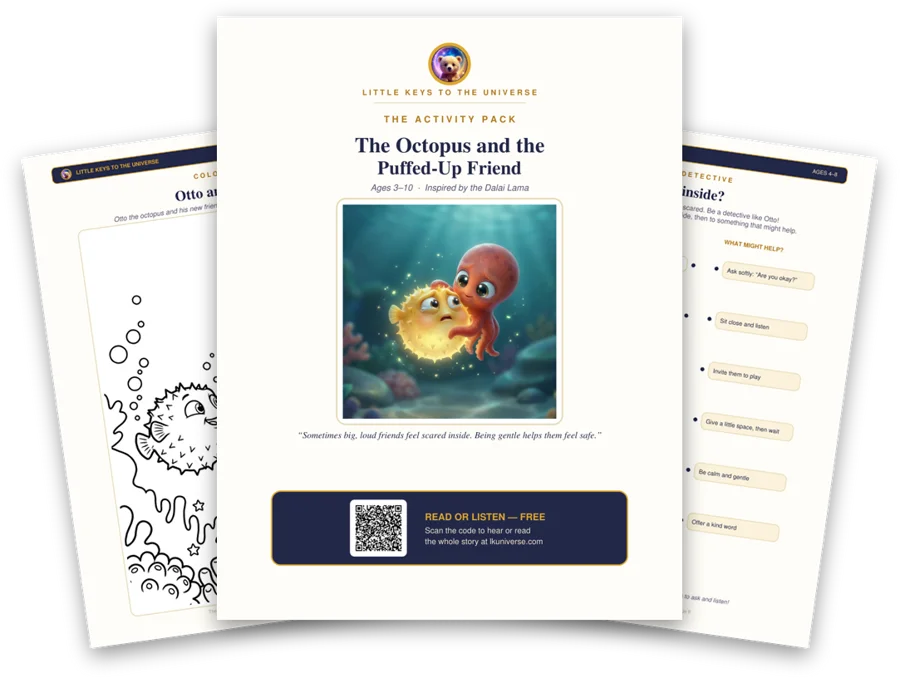

This story is inspired by His Holiness the Dalai Lama, a wise leader who teaches that kindness and empathy can make the world a more peaceful place. He reminds us that when we take the time to understand how someone else feels, we bring more happiness—not just to them, but to ourselves as well.
So take a deep breath, feel the ocean’s gentle rhythm, and let the waves guide you into a story about seeing beyond what we think we know… and finding connection in the most unexpected places.
Otto the Octopus loved playing in the coral reef. He zipped between rocks, twisted his arms into silly shapes, and changed his colors with his moods—yellow when happy, purple when nervous, blue when sad.
Today, he was bright yellow, which meant he was extra happy. He wanted to find someone to play with!
As he swam past a cluster of sea fans, he spotted Poldi the Pufferfish near the sandy ocean floor. But something was wrong.
Poldi was puffed up—round like a spiky balloon!
Otto stopped. His yellow faded to purple.
"Uh-oh," Otto thought. "Poldi must be REALLY mad!"
He quickly turned away and swam off.
But as the day went on, Otto kept noticing Poldi. Still alone. Still puffed up.
Something about it bothered Otto.
That afternoon, as Otto floated by the reef, he saw Leni the Manta Ray gliding gracefully through the water.
“Otto, why do you look so blue?” Leni asked.
Otto looked down—his skin had turned soft blue, his sad color.
“I saw Poldi earlier,” Otto said, “but he was all puffed up. I think he’s really mad, so I stayed away.”
Leni tilted her wide head. “Are you sure he’s mad?”
Otto blinked. “Well… he looked mad.”
Leni gave a gentle swirl of her fins. “Hmm. But did you ask him?”
Otto hesitated. “No…”
Leni smiled. “Sometimes, things aren’t what they seem. Just because someone looks a certain way doesn’t mean we know how they feel. The best way to understand someone is to ask and listen.”
Otto’s skin swirled pink—his thinking color.
Maybe Poldi wasn’t mad.
Maybe… he was something else.
There was only one way to find out.
Otto swam carefully toward Poldi. The pufferfish saw him coming—and puffed up even bigger!
Otto almost turned purple again and swam away.
But this time, he didn’t.
Instead, he stayed.
He took a deep breath and asked, “Poldi… are you mad at me?”
Poldi blinked. “What?”
“I thought you were mad,” Otto said. “Because you were puffed up.”
Poldi let out a soft sigh, and a tiny bit of air escaped from his puffed-up body.
“No… I’m not mad,” he said. “I just… get nervous.”
“Nervous?” Otto asked.
Poldi nodded. “Whenever I feel scared, I puff up. I can’t help it. But then everyone thinks I’m angry, and they stay away.”
Otto’s colors shifted—not purple, not blue, but a mix of colors. A new feeling.
Understanding.
“I thought you were mad… but really, you were just scared,” Otto said.
Poldi sighed again. “Yeah. I thought no one wanted to play with me.”
Otto thought about how he would feel if everyone stayed away from him. His skin turned soft orange—his kindness color.
“I get scared too, sometimes,” Otto admitted. “Maybe we could be scared together?”
Poldi’s spikes flattened as he let out a long breath. He wasn’t puffy anymore.
“Yeah,” Poldi said with a small smile. “I’d like that.”
From that day on, Otto never guessed how someone felt—he always asked.
And Poldi? He didn’t puff up as much anymore—because now, he had a friend who understood.
As they played, Leni watched from a distance and smiled.
Empathy was like an ocean current—it could change everything.
And so, Otto learned that understanding someone starts with a question, not an assumption.
Instead of guessing how Poldi felt, he listened—and in that moment, something magical happened. A new friendship was born, built on kindness and empathy.
The Dalai Lama teaches us that when we take time to truly see and listen to others, we bring more peace—not just to them, but to ourselves, too.
Every day, we have the chance to make the world a little softer, a little warmer, just by caring about how others feel.
So next time you see someone who looks sad, or scared, or even angry, remember Otto’s lesson.
Ask. Listen. And maybe, just maybe, you’ll find a new friend waiting for you.