
The stars twinkled softly in the night sky, their light gently guiding you toward the Magic Door. As it appeared, glowing faintly, you felt a sense of wonder pulling you closer. When you stepped through, you found yourself in a vibrant forest where sunlight filtered through shimmering leaves, and the air hummed with the soft sounds of life.
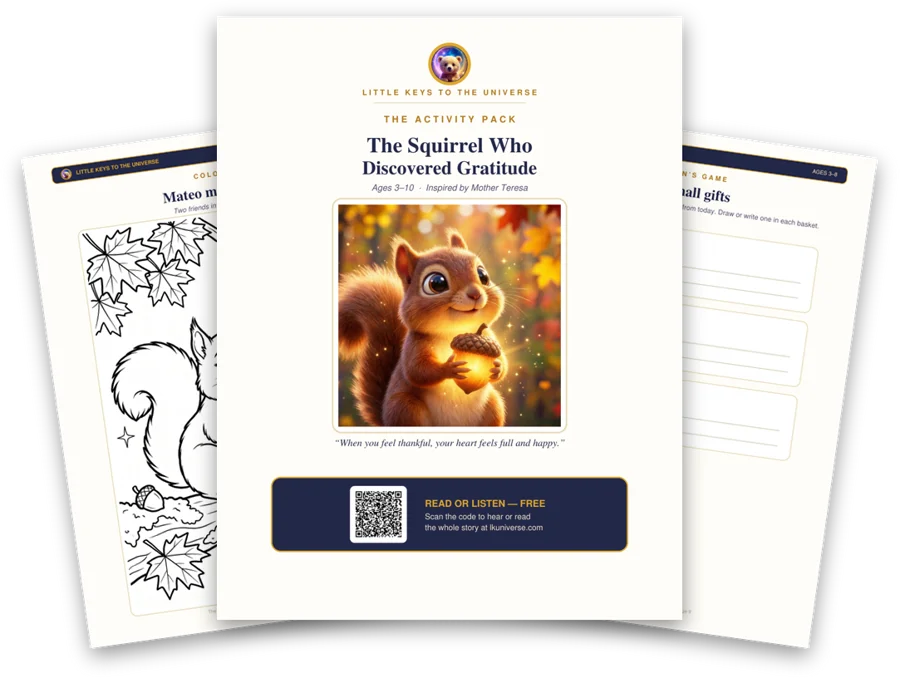
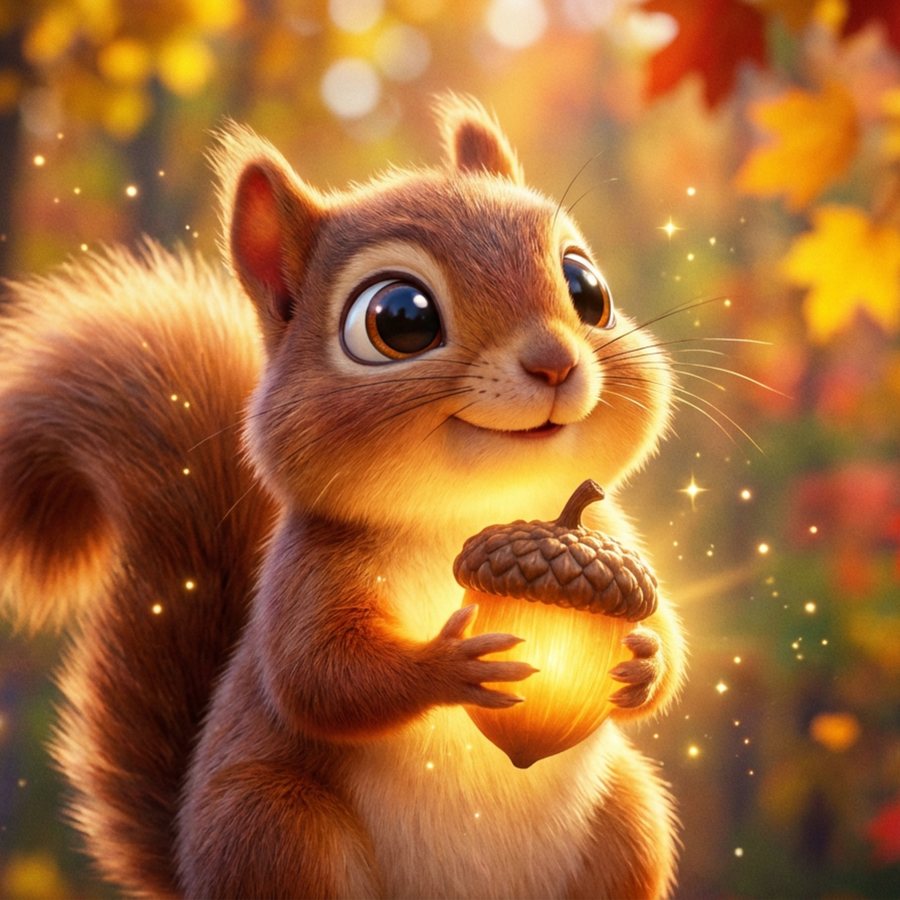
In this magical place, animals were busy preparing for the changing seasons. Yet, under the grandest tree of all—a tall, ancient oak with glimmering leaves—sat a young squirrel named Mateo. His fluffy tail twitched in frustration as he stared at his small, messy nest high above.
"I’ll never have a cozy home like the others," Mateo muttered, his paws fidgeting with an acorn. "My nest is too small, my branches too plain, and my acorns are just... ordinary. Why don’t I ever have what I really want?"
The leaves above him rustled softly, and a cheerful robin swooped down to perch on a nearby branch. Her feathers shimmered in the sunlight as she chirped, “Hola, Mateo! Why the long face?”
Mateo sighed deeply. “It’s my nest, Ruby. It’s nothing like the fox’s warm den or the owl’s big hollow tree. I just wish I had more—better branches, shinier acorns, something special.”
Ruby tilted her head, her eyes twinkling. “Hmm, I think I know what you need. Come with me.” With a flutter of her wings, she led Mateo deeper into the forest.
They soon arrived at the base of the tallest tree Mateo had ever seen. Its massive trunk seemed to glow faintly, and its shimmering leaves rustled gently, as if whispering secrets.
“This is the Whispering Tree,” Ruby said. “It’s been here for generations, but it only speaks clearly to those who practice gratitude.”
Mateo wrinkled his nose. “Gratitude? What’s that supposed to do?”
Ruby hopped closer. “Gratitude is like a magic key. When you say ‘thank you’ for the little things, this tree grows stronger, and its leaves whisper louder. But the real magic? It changes how you see the world—and your nest.”
Mateo looked doubtful but decided to give it a try. “Okay, fine. What do I do?”
Ruby pointed her beak at a patch of sunlight nearby. “Start small. Look around and say thank you for something.”
Mateo glanced at the sunlight, then at Ruby. “That’s it? Alright… thank you, sun, for being warm.”
The tree’s leaves rustled a little louder, their whispers forming a soft melody. Mateo’s ears perked up.
Ruby clapped her wings. “See? It’s working! Try again.”
Mateo hesitated, then looked at the sturdy branch beneath his paws. “Thank you, branch, for holding me up.”
The whispers grew clearer, like a gentle hum filling the forest. Mateo’s tail twitched with curiosity. “Thank you, acorns, for being tasty,” he said. The hum grew warmer, and Mateo felt a strange, light sensation in his chest.
But as Mateo got caught up in the moment, he suddenly frowned and said, “Well, I guess it’s easy for the fox or owl to feel thankful—they already have everything they want.”
The whispers instantly stopped, and the tree’s glowing leaves seemed to dim. Mateo’s tail drooped. “What happened? Did I break it?”
Ruby fluttered down to perch on his shoulder. “Not quite, Mateo. Gratitude isn’t about comparing yourself to others. It’s about noticing what’s good in your own life. Let’s try again, but this time, keep the focus on you.”
Mateo sighed but nodded. He looked around and said softly, “Thank you, breeze, for cooling me off. Thank you, forest, for keeping me safe.”
The tree’s whispers returned, stronger than before, and its leaves shimmered once again. Mateo smiled as he continued. “Thank you, leaves, for making shade. Thank you, moss, for making the ground soft to sit on.”
Ruby beamed. “There you go! Gratitude works best when it comes from your heart, not from wishing for what others have.”
Mateo’s frustration started to melt away. He rushed back to his nest, where the same small branches and plain acorns waited. But this time, they didn’t feel boring. “Thank you, nest, for keeping me safe. Thank you, branches, for giving me a place to rest.”
As the words left his lips, the tree’s whispers echoed through the forest, filling the air with a peaceful hum. Mateo curled up in his nest, feeling cozy and happy for the first time in ages.
Ruby watched from her perch, her feathers glowing in the golden light. “See, Mateo? Gratitude doesn’t just change the tree—it changes you.”
“And so, Mateo discovered that his words could change the world around him. The key he found unlocked a simple truth: gratitude makes the world brighter, just like kindness.