
The stars twinkled brightly in the quiet night sky, guiding you toward the Magic Door. As it appeared before you, glowing softly, a sense of curiosity pulled you closer. When you stepped through, you found yourself by a shimmering pond surrounded by lush green trees. The water was crystal-clear, reflecting the sky above, and it hummed softly, as though alive.
This is no ordinary pond—it’s the Ripple Pond. Its surface reacts to the emotions of those nearby, rippling gently with joy or shimmering brightly with calm. But when strong, unsettled emotions fill the air, the pond’s ripples grow chaotic, stirring up mud from the bottom.
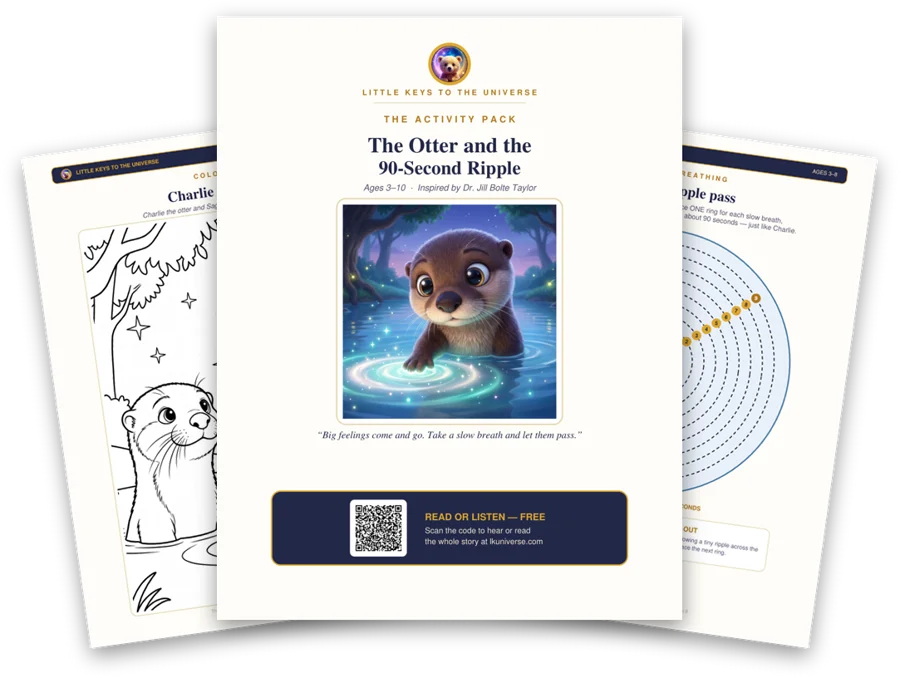
Nearby, a young otter named Charlie splashed excitedly, his sleek fur glistening in the sunlight. He and his friends were in the middle of a playful game, chasing each other across the water and leaping into the air.
“I’m going to make the biggest splash ever!” Charlie shouted, diving high and landing with a giant whoosh! Water sprayed everywhere, sending ripples across the pond. But as Charlie surfaced, he froze. The water had soaked the picnic his friends had set up on the shore, and their snacks were soggy and ruined.
“Aw, Charlie!” one of his friends groaned. “Look what you did!”
“Why didn’t you watch where you were splashing?” another complained.
Embarrassed and nervous, Charlie stammered, “I-I didn’t mean to!” But the damage was done, and his friends paddled away to sit quietly by the shore.
Frustrated and ashamed, Charlie slapped the water with his tail. “Why do I always mess things up?” he muttered. His emotions stirred the pond into chaotic waves, muddying the once-clear water. The ripples grew larger and more erratic, echoing Charlie’s feelings.
A graceful heron named Sage, perched on a nearby rock, watched calmly before gliding over. Her feathers gleamed silver in the sunlight, and her voice was steady and soothing. “Hello, Charlie. What’s got your ripples in a twist?”
Charlie looked up, his whiskers drooping. “I ruined everything. My friends are mad at me, and I don’t know how to fix it. Now I’m just making it worse.”
Sage tilted her head. “I see,” she said, eyeing the stormy water. “Did you know the Ripple Pond reflects more than just your splashes? It mirrors your feelings, too.”
“My feelings?” Charlie asked, confused.
Sage nodded. “When your emotions get tangled up, the pond does, too. But here’s the thing—those feelings don’t have to last. Let me tell you about the 90-second rule.”
Charlie blinked. “What’s that?”
Sage stepped closer, her calm presence steadying the chaos around them. “When you feel something—like embarrassment or frustration—your body reacts for about 90 seconds. After that, the feeling fades, if you let it go. But if you hold onto it, your thoughts keep the storm going, just like your splashing keeps the pond muddy.”
Charlie looked at the murky water. “So… if I stop being mad, the pond will calm down?”
“Exactly,” Sage replied. “Take a deep breath. Let’s count to 90 together.”
Charlie hesitated but nodded, closing his eyes as he took a shaky breath. Sage counted softly, her voice like the gentle rustling of leaves. “One… two… three…”
But before she reached 20, Charlie opened one eye and groaned. “It’s not working, Sage! The pond’s still muddy, and I feel the same!”
Sage chuckled warmly. “It’s not about watching the pond or waiting for it to magically clear. It’s about letting the ripples settle. Close your eyes again, and this time, imagine the water calming with every breath.”
Charlie sighed but gave it another try. He closed his eyes and listened to Sage’s voice. “Picture the ripples shrinking smaller and smaller,” she said gently. “Imagine the pond clearing, like soft clouds fading into a blue sky.”
As Charlie breathed deeply, he began to see the ripples in his mind settling. By the time Sage reached 90, he felt his heart slow, and when he opened his eyes, the pond was clear again.
“See?” Sage said with a smile. “The ripples fade when you let them. And now that the pond is calm, you can decide what to do next.”
Charlie gazed at the water, a small smile creeping onto his face. “I guess I was making it worse by rushing and staying mad.”
Sage nodded. “Exactly. Calming your ripples gives you space to think clearly. What’s one thing you can do to make things right?”
Charlie’s eyes brightened. “I could find some new snacks for my friends! There’s a berry bush near the stream—we can have a better picnic.”
Sage spread her wings. “That sounds like a wonderful idea. Off you go.”
Charlie swam to the shore, shaking off the last bit of worry. His friends looked up as he paddled over. “I’m really sorry for ruining the snacks,” he said. “I found some berries we can share.”
His friends exchanged glances, then smiled. “Thanks, Charlie,” one of them said. “That was really nice of you.”
As the group laughed and shared the berries, the Ripple Pond glowed brightly, its surface shimmering with calm and joy. From her perch above, Sage watched with a satisfied smile.
“And so, Charlie discovered that emotions, like ripples in the water, don’t have to stay forever. By letting go of frustration and giving his feelings time to settle, he was able to think clearly and make things right.