Sometimes, we believe a story about what someone else did or said—but we only see it through our own eyes. What if we paused, just for a moment, to see the world through theirs?
In a lively green jungle where vines swayed and parrots called from the trees, lived a young monkey named Mika. Mika was full of bounce, clever ideas, and energy that made her friends giggle and groan all at once.
Her best friend was Kato the Chameleon. They had played together since they were tiny—building leaf forts, racing through branches, and sharing fruit by the river.
But lately, something felt different.
That morning, Mika had swung over to Kato’s branch with a new joke and an idea for a game. She couldn’t wait to share it. But when she landed, Kato was already sitting with two other animals—Naya the Parrot and Finn the Tree Frog—laughing about something she didn’t understand.
She waved. But Kato didn’t wave back.
“Hey! I have an idea for a new game!” Mika chirped, her tail flicking with excitement.
Kato looked at her for a second, then turned back to the others. “Maybe later,” he mumbled.
And then… they kept laughing.
Mika’s heart sank.
She swung away without another word, pretending it didn’t matter. But it did.
All day, Mika stewed. Her thoughts swirled like a storm.
Kato doesn’t want to be my friend anymore. He likes Naya and Finn better. He didn’t even laugh at my idea. Maybe I’m annoying. Maybe he never really liked me at all.
The more she thought, the heavier it felt—like carrying a backpack filled with stones.
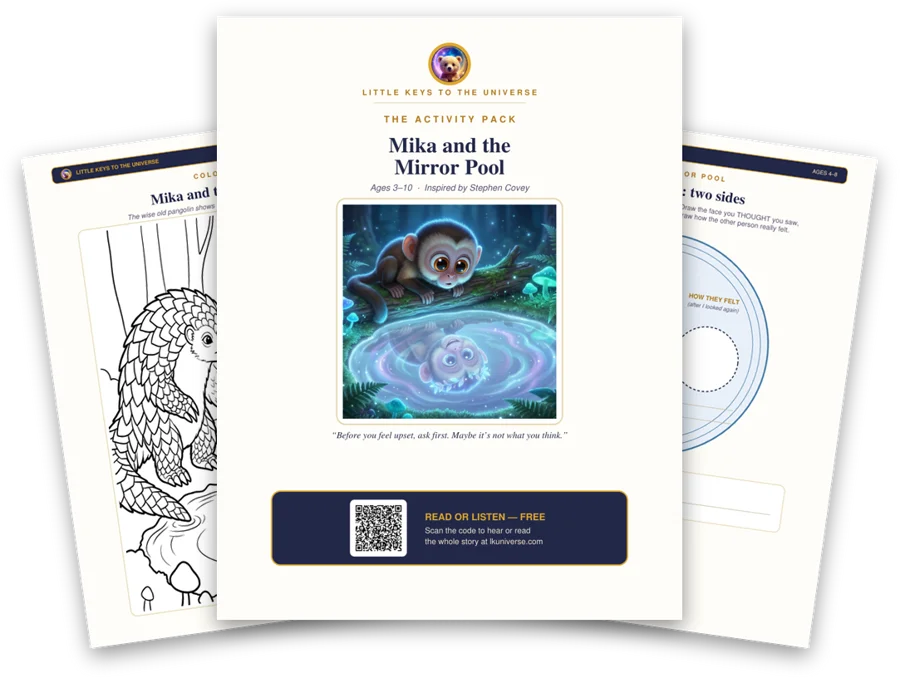
That night, unable to sleep, Mika wandered deeper into the jungle. The vines grew quieter here, the trees farther apart. Near the edge of a spring, the moonlight danced on a still pool of water.
A soft voice broke the silence.
“You brought a heavy story with you,” said someone nearby.
Startled, Mika turned. An old pangolin sat curled at the edge of the spring, her voice calm and low.
“What story?” Mika asked.
“The one in your mind,” the pangolin replied. “About what happened. Why someone did what they did. We all carry them. But they aren’t always true.”
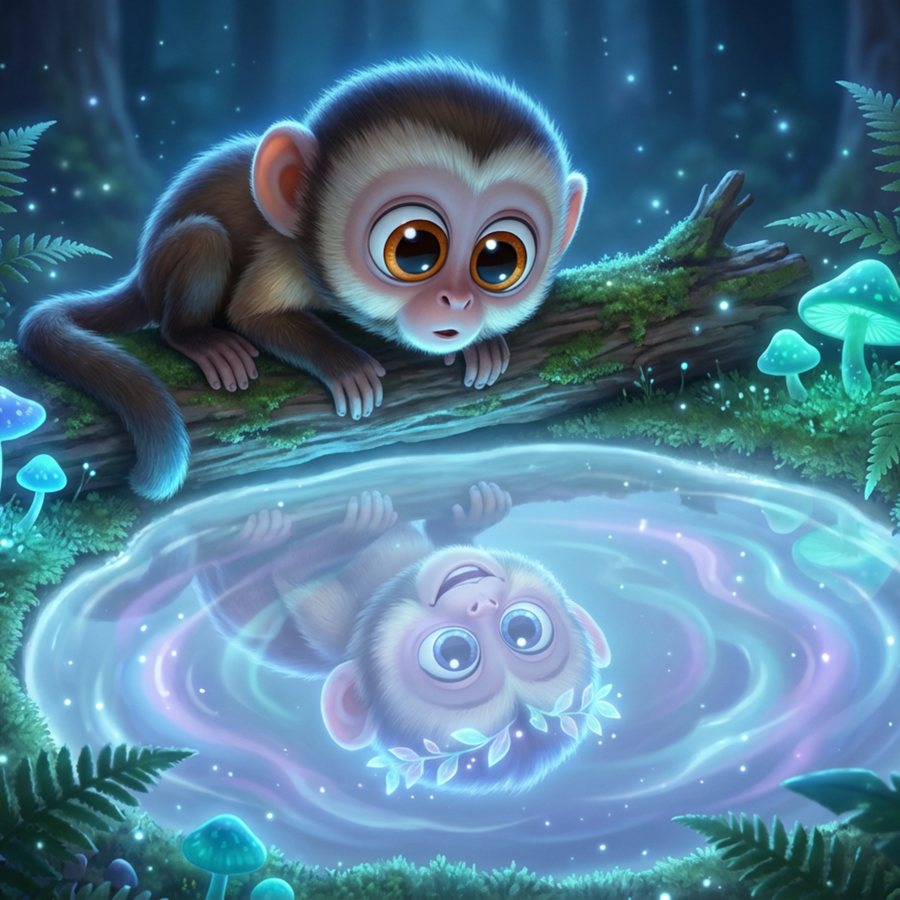
She nodded to the pool. “Come. This is the Mirror Pool. It shows not just what happened—but how it felt from both sides.”
Mika hesitated, then stepped closer. The surface shimmered, and suddenly she saw the moment from earlier that day—only now, from above.
There she was, swinging in full of excitement. There was Kato, sitting with the others. But now she noticed something different: his eyes looked tired. He fiddled with his tail. His smile didn’t quite reach his eyes.
“Now,” said the pangolin, “look again.”
The water rippled, then shifted. This time, Mika saw the jungle through Kato’s eyes.
The colors were loud. The noise felt sharp. So many voices. Too many faces.
When Mika swung in—bright and bouncing—it wasn’t that Kato didn’t like her. It was that he already felt full, like a bowl with no more room. He wasn’t trying to leave her out. He just didn’t know how to handle more.
Mika’s chest tightened.
“He wasn’t ignoring me,” she whispered. “He was overwhelmed.”
The pangolin nodded. “We often believe what we see is the full picture. But every animal has their own world inside them. You don’t have to guess their story. You can ask.”
The next morning, Mika found Kato near the river. He was alone, tossing pebbles into the water.
She sat beside him quietly. Then, in a gentle voice, said, “Hey... yesterday, I thought you didn’t want me around. But then I looked a little deeper. Were you feeling okay?”
Kato blinked. Then his shoulders softened.
“I was just... tired,” he admitted. “Sometimes, when too many animals talk at once, I get overwhelmed. I didn’t mean to ignore you. I just didn’t know how to say it.”
Mika nodded. “Thanks for telling me. I get carried away sometimes, I know. Next time, just wave or give me a little sign, and I’ll give you space.”
They sat for a while, listening to the wind move through the leaves. It felt good—not to fix something, but to understand it.
Then Kato smiled. “Want to show me your new game?”
Mika beamed. “Absolutely.”
And so, Mika the monkey learned that sometimes our thoughts tell stories that aren’t fully true. And the best way to understand someone else is not to guess—but to pause, to feel, and to ask.
Because what we think we see is only a reflection. Sometimes, the clearest view comes when we look again—with a little more heart.