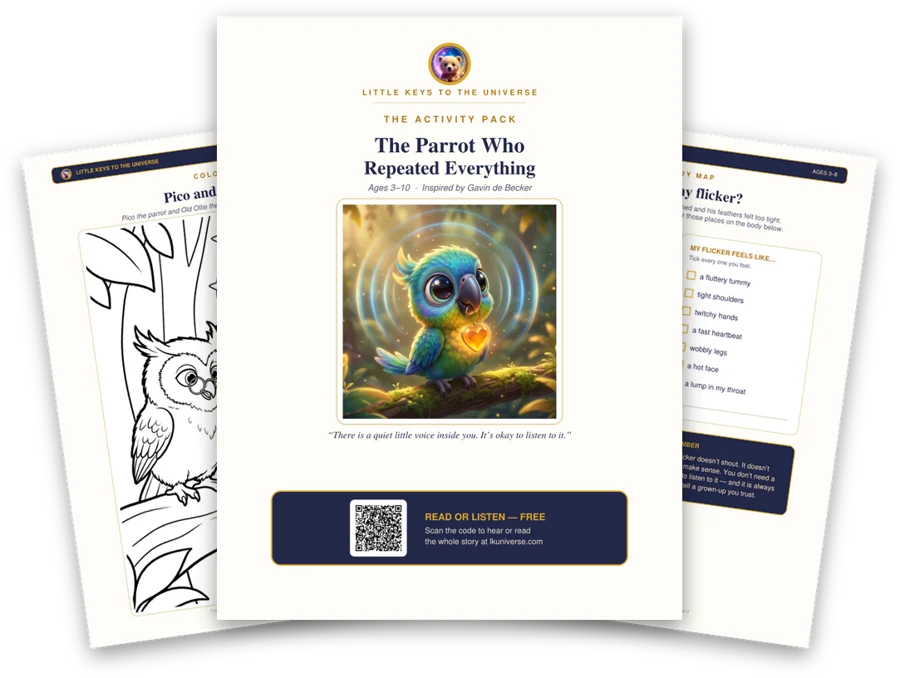

This story is inspired by Gavin de Becker, a wise protector who reminds us that gut feelings aren’t silly or strange—they’re signals. Warnings. Inner gifts that speak through quiet feelings, not loud explanations. And when something doesn’t feel right, we don’t need to explain why. We just need to trust the feeling.
Let’s take flight into the canopy, where a young parrot is about to learn the power of listening to his own instincts.
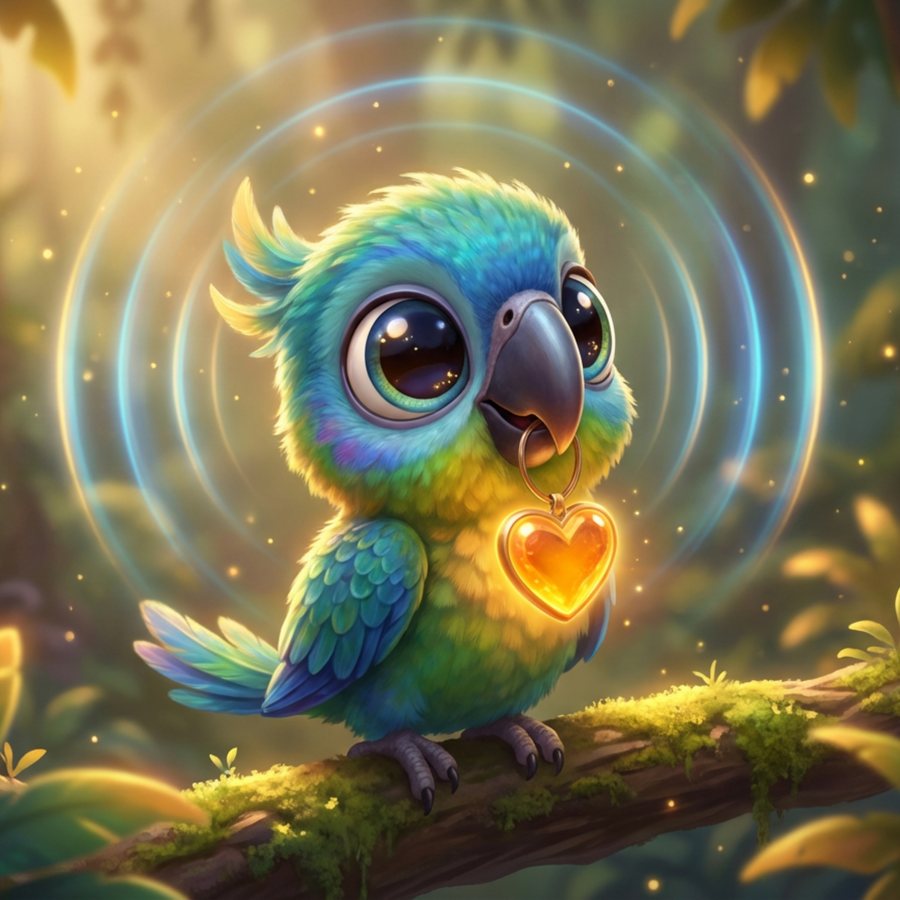
Pico the Parrot was the chattiest bird in the forest.
He had the brightest feathers, the loudest laugh, and a habit of repeating almost everything he heard.
“Hello there!”
“Want a snack?”
“What a lovely tail you have!”
Pico didn’t just mimic voices—he trusted them, too.
“If someone sounds nice, they must be nice,” he often said with a cheerful squawk.
The other birds loved Pico. He was fun, friendly, and always full of life. But one day, all that chirping would be tested.
At the edge of the forest stood the treetop market, where birds from faraway branches came to trade berries, swap stories, and sing new songs. Pico adored it. The smells, the colors, the noise—it all filled him with excitement.
One afternoon, as sunlight painted gold across the leaves, a new parrot arrived.
He had feathers that shimmered like jewels. A voice as smooth as syrup. And compliments that sparkled like sugar.
“Pico! I’ve heard of you,” the new parrot said warmly. “You’re the friendliest bird in the canopy.”
Pico puffed up with pride. “Well, I do try!”
The new parrot leaned in closer. “I have a collection of golden seeds—hidden just past the market ridge. I don’t show them to everyone, but I’d love to show you.”
Pico opened his beak to say “Sure!”
But something inside him… shifted.
His belly fluttered in an odd way.
His wings twitched.
His feathers suddenly felt too tight.
The new parrot was smiling. He sounded kind. He looked confident.
But Pico felt… strange.
He didn’t know why.
Had the other parrot done anything wrong? Not really.
Was Pico being rude by hesitating? Maybe.
Still, that flutter in his belly wouldn’t go away.
Later, Pico sat on a quiet branch, the market sounds fading behind him. He didn’t feel like repeating anything. He didn’t feel like puffing up or being proud.
That’s when Old Ollie the Owl glided down and settled beside him.
“Why so quiet, little chatterbox?” Ollie asked gently.
Pico blinked. “I felt something weird today.”
He told Ollie about the new parrot—the smooth words, the sparkling feathers, the secret invitation.
When he finished, Ollie didn’t laugh.
He didn’t say, “Oh, I’m sure it was nothing.”
He simply nodded and said, “That feeling? That was your flicker.”
“My what?”
“Your flicker,” Ollie repeated. “It’s that tiny spark inside you that says, ‘Wait… something’s off.’ It doesn’t shout. It doesn’t always make sense. But it’s there for a reason. We all have it. You felt it—and that means it’s working.”
“But he seemed so nice,” Pico whispered.
“Sometimes, strange behavior hides behind friendly words,” said Ollie. “But behavior tells the truth—even when voices don’t.”
Pico sat very still. He understood.
From then on, when Pico heard sweet words or saw shiny smiles, he listened a little deeper. Not just to what was said—but to how he felt inside.
And when the flicker came back—even the tiniest flutter—he didn’t ignore it.
He didn’t need proof.
He didn’t need a reason.
He just needed to trust the part of him that knew something was wrong.
And so, Pico the Parrot learned that protecting yourself isn’t about being scared. It’s about paying attention. It’s about listening—to the flutter in your belly, to the quiet voice inside that hums when something doesn’t feel right.
As Gavin de Becker teaches, your instincts are wisdom wrapped in feeling. They are your early warning system. And you don’t need to explain them to anyone.
You are allowed to pause.
You are allowed to say no.
You are allowed to listen to your flicker.
Because sometimes, that small feeling is the one that keeps you safe.