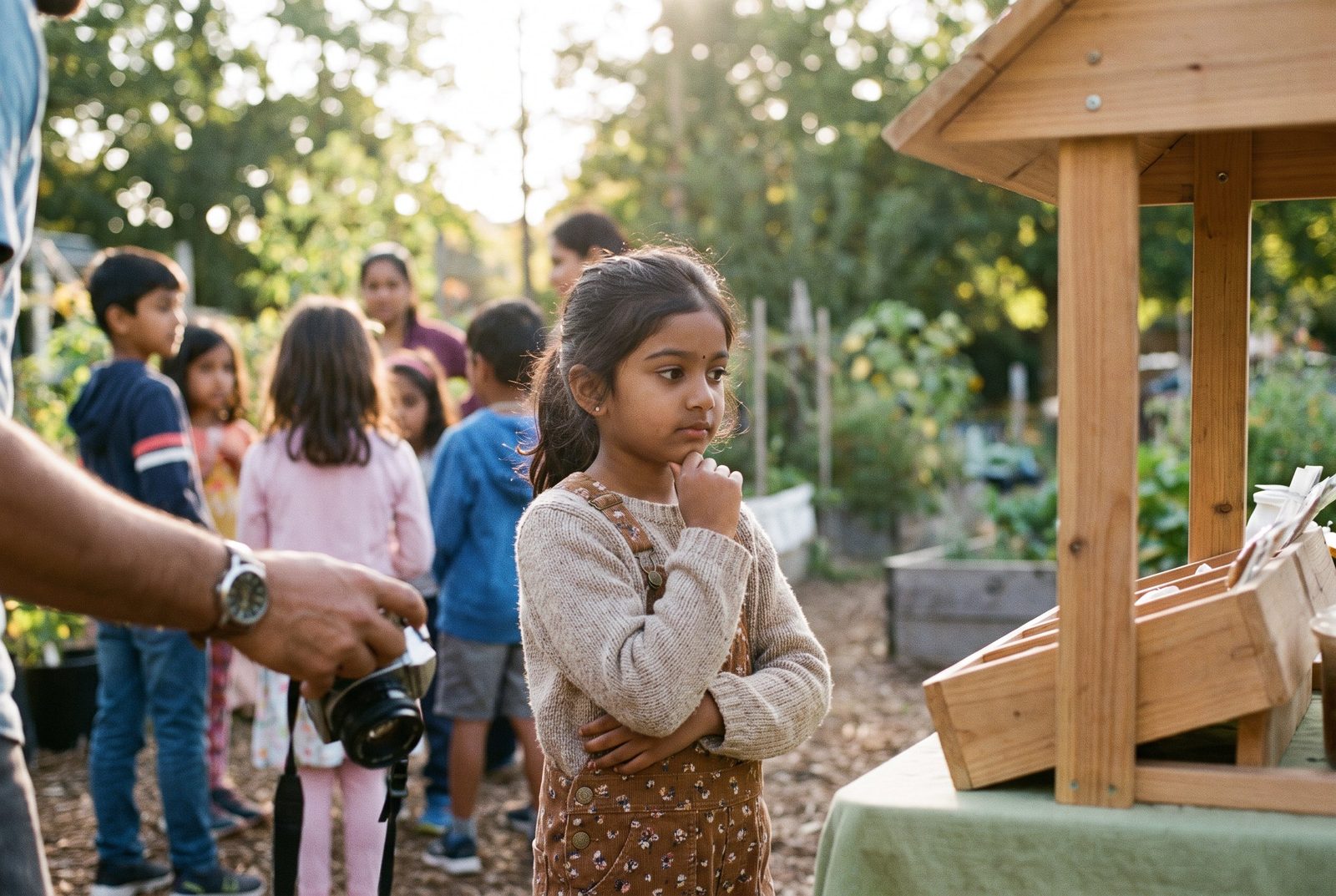
How to teach your child to think for themselves: ask before you tell, have them check "everyone says" ideas, and praise their reasoning. Age-by-age steps for kids 3 to 12.
The short answer: you teach a child to think for themselves by asking before you tell. Ask “what do you think?” first, help them check whether an idea is something they saw or just something they heard, and praise how they reasoned, not only whether they got it right. Done a little every day, that turns “everyone says” into “let me check.”
“But everyone says it’s true.” “Everybody’s doing it.” The first time a child uses the crowd as evidence, it’s a small milestone — and a small warning. They’ve started borrowing beliefs from the group without stopping to check them against reality. Learning to notice the difference between a thought they inherited and one they actually looked at is a skill that protects them for life.
Why kids follow the crowd — and why it matters
Fitting in with the group is powerful for young children, and for good reason: belonging once meant safety. So a child will often adopt the group’s belief — this hill is scary, that kid is weird, this is the fun thing to do — without ever checking it themselves. The striking part is how far it goes: in classic studies, young kids will sometimes agree with a group even against what they can plainly see with their own eyes. The pull to match the crowd can override their own perception.
This isn’t a flaw to shame out of them — some of it is healthy social learning. But left unexamined, “everyone says” becomes a habit that carries straight into the years when the crowd’s ideas get riskier. The antidote isn’t teaching a child to defy the group; it’s teaching them to check. To notice when a belief was simply handed to them, and to look at it with their own eyes before deciding it’s true. A child who can ask “have I actually checked this, or did I just hear it?” has a kind of independence most adults are still working on.
The goal isn’t a contrarian kid who rejects everything. It’s a child who can belong to their group and keep their own eyes — who knows that not every thought in their head is actually theirs.
Ways to nurture independent thinking
- Ask “what do you think?” first. Before offering your view, let them form their own.
- Distinguish borrowed from checked. “Is that something you’ve seen, or something you heard?”
- Praise their reasoning, not just the right answer. “Tell me how you figured that out.”
- Let them be right when the crowd is wrong. Notice and honor it out loud.
- Model checking. “People say that — let’s find out if it’s actually true.”
- Don’t punish respectful disagreement. A kid who can push back kindly with you can resist pressure elsewhere.
- Wonder out loud about “everyone.” “Who’s everyone? Have they checked?”
- Give them safe practice. Low-stakes “do you agree?” moments build the muscle.
- Value curiosity over compliance. A questioning child is a thinking child.
- Let a story carry it. A character who finally looks with her own eyes shows it best.
How to teach your child to think for themselves, age by age
Ages 3–5: build the “what do you think?” habit.
- Offer small, real choices (“the red cup or the blue one?”) and ask why they picked it.
- When they ask you a question, sometimes turn it back first: “What’s your guess?”
- Read a picture book and pause: “What do you think happens next?”
Ages 6–8: separate “I heard” from “I checked.”
- When “everybody says” comes up, ask: “Is that something you saw, or something you heard?”
- Do tiny experiments together (does the heavier ball really fall faster?) so they feel what checking is like.
- Let them disagree with you respectfully, and say out loud when they’ve made a good point.
Ages 9–12: practice reasons and evidence.
- Ask “How do you know?” and “What would change your mind?” about ads, videos and playground rumors.
- Have them argue the other side of something they believe, just for practice.
- Talk through a time you went along with a crowd and what you’d do differently.
Tonight’s story shows the payoff of looking
The Lamb Who Learned to Think follows a lamb who believes whatever the flock believes — until, alone for the first time, she looks at the “scary” hill with her own eyes and finds it covered in the sweetest clover. It’s inspired by Bob Proctor and his teaching on awareness: noticing which of our beliefs are truly our own.
Tonight’s tiny plan
- Play the story before lights-out.
- Ask: “Is there something ‘everyone says’ that you’ve never checked yourself? What might you find?”
- Tomorrow, when “everybody” comes up, gently ask them to look for themselves.
Want to keep it going off-screen? Our printable activity packs turn the stories into coloring, mazes and bedtime talk cards for ages 3–10.
Your child will always feel the pull of the crowd — we all do. The gift is teaching them to keep their own eyes open inside it.